Working Session at EU parliament


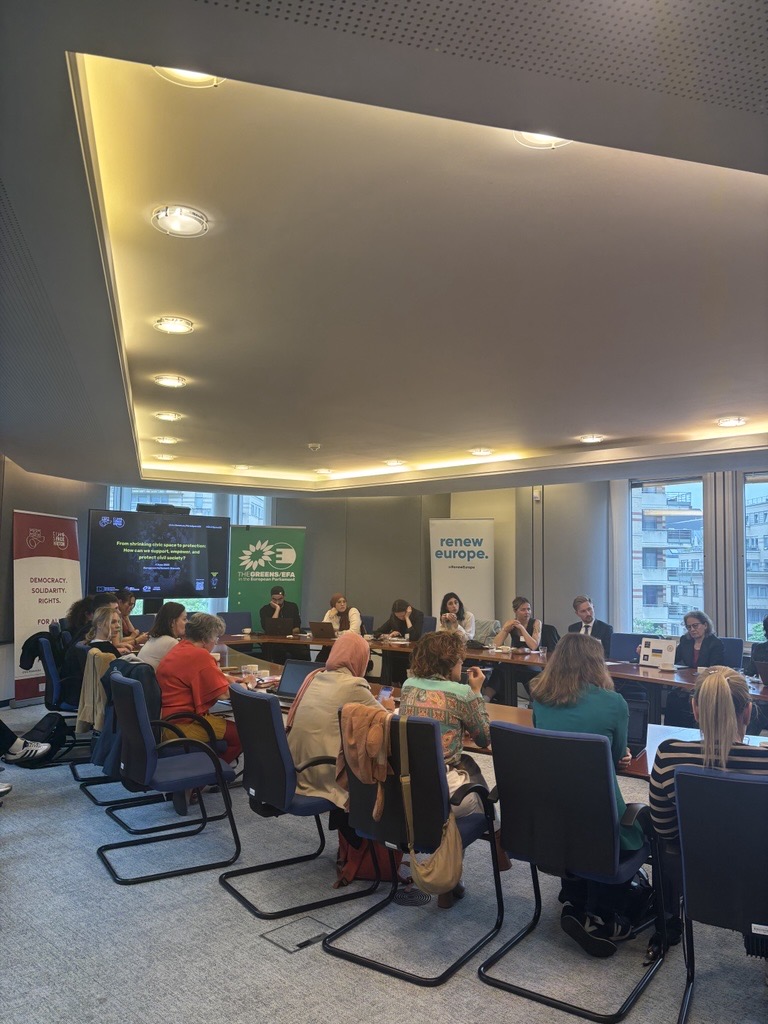
On the 4th of June the Net4Defenders project organized a cross-party event in the European Parliament in which the Civic Space Report was presented. The event brought together civil society partners and HRDs from across Europe, Brussels-based networks, high-level policymakers from the European Commission and members of the European Parliament. The report documents the space for civil society in EU and Western Balkans states and has become the go-to guide for understanding the state of civic space in Europe. During the event, ECF will present its key findings from the report, followed by a roundtable discussion amongst policy makers, HRDs and civil society, which will focus on unpacking strategies to protect the shrinking civic space in Europe. This includes the need for an EU-wide protection mechanism and Early Warning and Alerts system, as well as reflections on the upcoming Civil Society Strategy and Democracy Shield. The event is being organized as part of the Net4Defenders project, co-funded by the European Union, which aims to build the capacities of activists on the ground to monitor and respond to civic space restrictions and illiberal tendencies; developing national protection hubs to provide support to civil society under attack; and advocating for a thriving civic space. The project partners will share their expertise on needs, gaps and strategies to protect HRDs and civic space.

E-library

The E-Library is an online learning space offering a collection of self-paced courses designed to strengthen the digital capacities of civil society actors and human rights defenders. Through this platform, participants can explore key tools and strategies to better protect civic space, drive social change, and ensure that technology aligns with human rights values.

Developed as part of the Digital Organising program, the E-Library empowers journalists, activists, and civil society organisations across the Euro-Mediterranean region. It promotes critical awareness of digital environments, and supports communities to leverage technology for activism while addressing risks such as surveillance, bias, and online repression.

The platform features 10 autonomous but interconnected modules, with practical exercises, case studies, and certification upon completion.

 Active courses available in the E-Library:

  1. Movement Building in the Digital Era
  2. Strategic Nonviolent Action in the Digital Age
  3. Systemic Conflict Analysis in Designing Digital Campaigns
  4. Fighting Impunity: Documenting Human Rights Violations
  5. Open Source Intelligence for Justice
  6. Digital Ecosystems: Aligning Communities and Infrastructures
  7. Digital Security: Essentials to Protect our Activism
  8. Strategic Communication for Citizen Journalism
  9. Digital Storytelling: The Call for Action
  10. Digital Campaigning: Amplify Your Advocacy

Explore the E-Library and start learning here: https://academy.novact.org

Defender’s Academy

In a time marked by democratic backsliding, systemic repression, and the shrinking of civic space, The Defender’s Academy aims to be a critical response and meeting point for those committed to defending human rights and democracy in the Euro-Mediterranean region. The Academy is not only a training program, but also a living space of solidarity, intergenerational learning, and collective resistance.

Held at the Centre Esplai Hostel, a sustainable and inclusive space that reflects the values of environmental and social justice, the Defenders Academy gathered in November 2024, nearly 60 participants from across the region: movement-builders, frontline communities, public servants, artists, and human rights defenders working across borders and struggles. In the face of rising authoritarianism, the Academy offered tools for civil resistance and nonviolent action as well as a space to imagine new futures grounded in justice, care, and belonging.

During the course of 6 days, the Academy offered a space for mutual learning, focusing on deepening thematic work around civil resistance while prioritizing intersectionality and geographic diversity. It placed particular emphasis on digital surveillance, collective security, and the urgent need to strengthen alliances between those resisting violent state and non-state actors, especially as oppression increasingly targets women, LGBTIQ+, racialized, and displaced communities.

From powerful testimonies by Palestinian and Sahrawi defenders to strategic workshops on fundraising, communications, and digital protection, the Academy became a living laboratory of nonviolence, with trainers and human rights defenders coming from both sides of the Mediterranean and Europe. Activities such as a public act on belonging, a visit to the Catalan Parliament, and daily spaces of psychosocial care, created an environment where community-building and critical learning were equally valued.